General Chemistry: Atomic Structure & Periodic Trends
Free MCAT study guide — Chemical and Physical Foundations of Biological Systems
Illustrated Guide& PDF
Full-color, printable companion to this guide — view online or download.
Gen Chem Visual Guide View Illustrated Guide
Atomic Structure
Atoms consist of protons (p⁺), neutrons (n⁰), and electrons (e⁻). The atomic number (Z) = number of protons defines the element. Mass number (A) = protons + neutrons.
Quantum Numbers
| Quantum Number | Symbol | Values | Describes |
|---|---|---|---|
| Principal | n | 1, 2, 3... | Shell / energy level |
| Angular momentum | l | 0 to n−1 | Subshell shape (s,p,d,f) |
| Magnetic | mₗ | −l to +l | Orbital orientation |
| Spin | mₛ | +½ or −½ | Electron spin |
Key Point: Aufbau: fill lowest energy first. Hund's rule: fill singly before pairing. Pauli: max 2e⁻ per orbital.
Periodic Trends
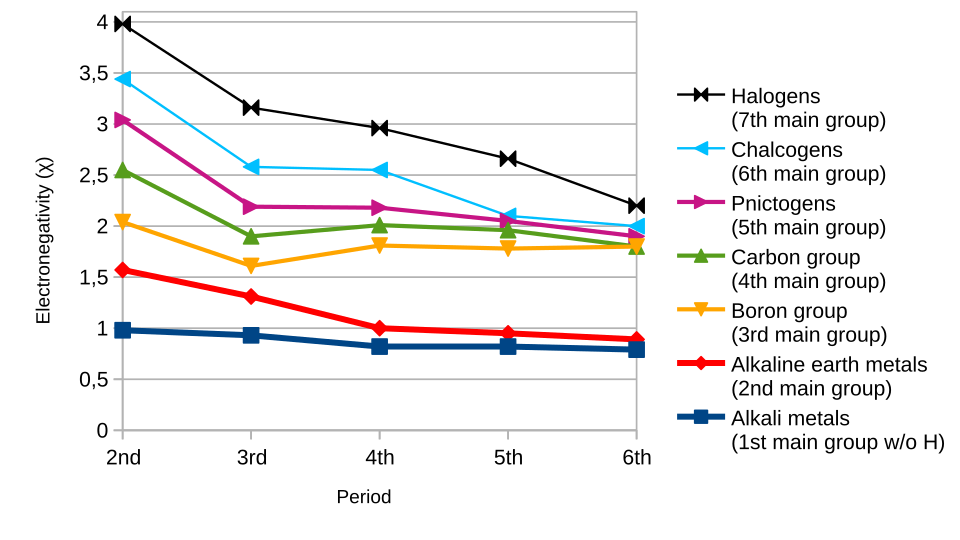
| Property | Across Period (→) | Down Group (↓) | Reason |
|---|---|---|---|
| Atomic radius | Decreases | Increases | More protons (→), more shells (↓) |
| Ionization energy | Increases | Decreases | Harder to remove e⁻ from smaller atoms |
| Electronegativity | Increases | Decreases | Smaller atoms attract e⁻ more strongly |
| Electron affinity | More negative | Less negative | Smaller atoms gain e⁻ more easily |
Key Point: Exceptions: IE drops at B (2s→2p) and O (paired 2p e⁻). Noble gases have very high IE and near-zero EA.
Nuclear Chemistry
| Decay Type | Particle | ΔZ | ΔA | Example |
|---|---|---|---|---|
| Alpha (α) | ⁴₂He | −2 | −4 | ²³⁸U → ²³⁴Th + α |
| Beta⁻ (β⁻) | ⁰₋₁e | +1 | 0 | ¹⁴C → ¹⁴N + β⁻ |
| Beta⁺ (β⁺) | ⁰₊₁e | −1 | 0 | ¹¹C → ¹¹B + β⁺ |
| Gamma (γ) | photon | 0 | 0 | Excited → ground state |
| Electron capture | e⁻ captured | −1 | 0 | ⁵⁷Co + e⁻ → ⁵⁷Fe |
Half-life: N = N₀ × (½)t/t½
Related Chemical and Physical Foundations of Biological Systems Study Guides
Acid-Base Chemistry and Buffer SystemsAtomic Structure and Periodic TrendsChemical Bonding and Molecular GeometryElectricity and Magnetism: Coulomb's Law to CircuitsElectrochemistry: Galvanic and Electrolytic CellsFluids and Circulation: Bernoulli, Poiseuille, and Blood Flow
Browse all free MCAT study guides or read MCAT strategy on the DoctorMCAT blog.
Practice What You've Learned
Test your understanding with our question bank and practice tests.
Start Practicing Free